
Puffer
-
Posts
1,978 -
Joined
-
Last visited
-
Days Won
46
Content Type
Forums
Profiles
Blogs
Events
Gallery
Everything posted by Puffer
-
Pick-ups are not at all common in the UK as 'family' vehicles, rather than for trade use, although my wife's (female) cousin does have one. I have a VW Passat diesel estate and can get a lot inside (such as a tall freezer) or on the roof rack. Only yesterday I collected a full 8 x 4 sheet of 25mm plywood (very heavy) from the timber merchant and took it on the roof rack to my stepson's house for some work there (window cills, suitably edged with a moulding). Well roped-down, transporting such an item presents few difficulties; I have safely carried even 4.8m timber - a little longer than the car - in that way. What is NOT fun is trying to load e.g. plasterboard single-handed, especially if there is a wind.
-
The position in much of the rural UK is very similar, albeit on a smaller scale. The big difference is the fuel price, although lower here now than recently. You are paying about 46p per litre; we currently pay (for unleaded petrol) around £1.30/litre - or almost three times as much. (Diesel is typically about 9-10p/litre dearer in UK.)
-
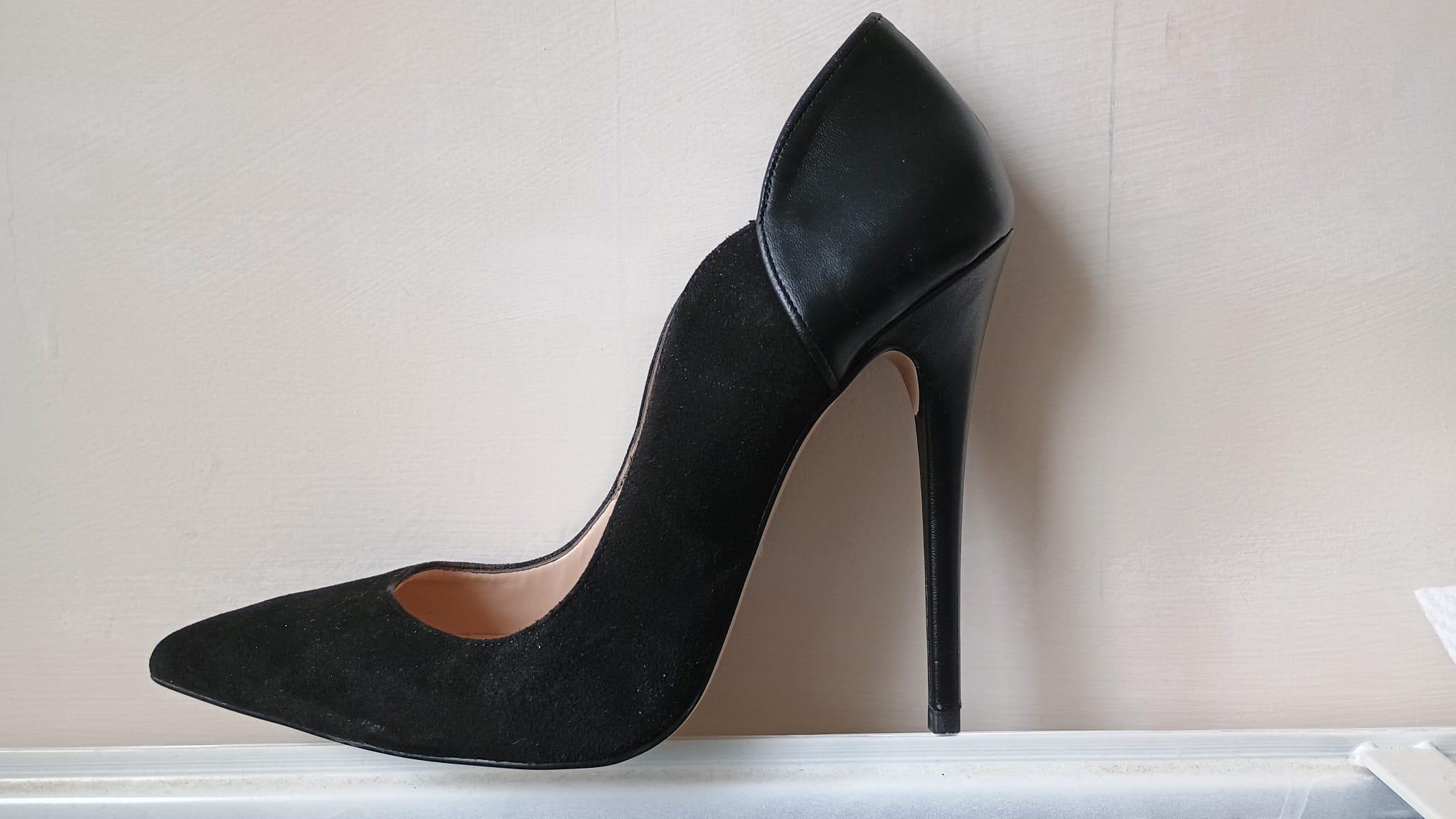
Yes, understood. A standardisation that helps comparison - provided we all understand and adopt the same standard, which mlroseplant takes as being the actual height of a Eu38 shoe heel. As good as anything. I expect the shoes I pictured above were sold as being 5", which they probably were in size 38.
-
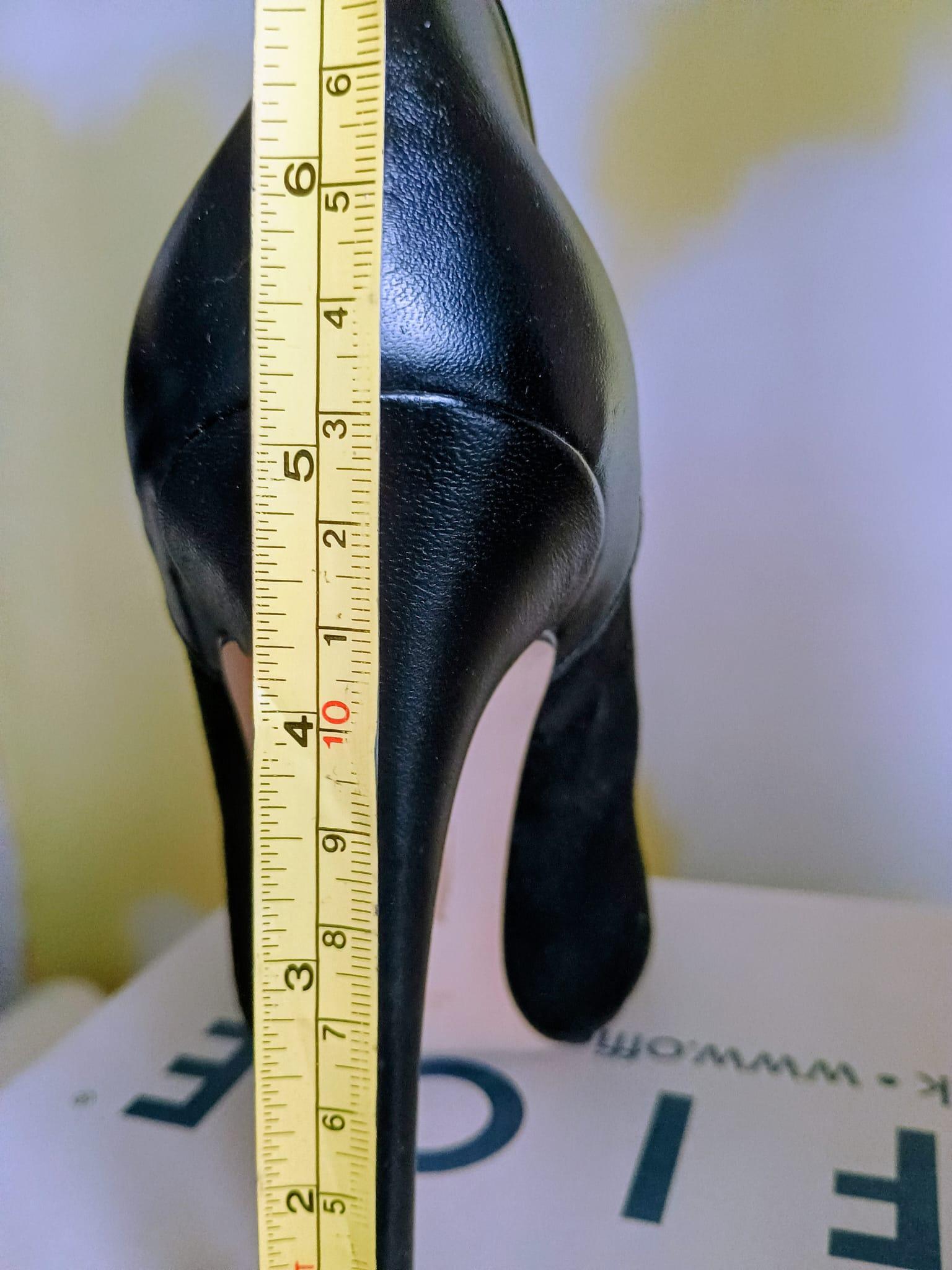
This was all getting rather confusing! I hadn't realised that you were describing heel heights by their 'standard' equivalent, and that the true measured height of yours is 14.7mm, which explains a lot as regards wearability. But it makes the pic look even odder - I would have guessed those heels as shown to be no more than 4.25" high in your size. I know what it is like to wear heels (probably same foot size as yours: UK 11/12) that are a truly measured 5" or 5.25" high - not easy; you have my further respect for 'managing' when practising in a true 5.75" heel! It would help mutual understanding if true heel heights were always quoted, with the 'standard equivalent' too if helpful when shoe size is not only marginally larger or smaller. These Office shoes (UK8) belonging to a friend have a true height of 131mm = 5.16". They look noticeably higher (and certainly steeper) than your boots.

-
Yes, very nice wearable boots. I have a similar pair from ASOS (slightly shorter shaft and no platform) which are ideal; for discreet outings. And my duplicate pair (unworn) are still available for purchase:
-
In the UK and most other European countries, the majority of the population live within a mile or two of most of the 'basic' facilities (shops, post office, public transport etc) that they need to access frequently. And some workers live similarly close to their workplace too. Walking to and from them is usually easy and safe, economical, and desirable from an exercise viewpoint. My impression is that the US is typically very different in that these 'local' trips often involve significantly longer distances and may be difficult or unsafe for walking - so the automobile reigns supreme. That said, the typical American shopping mall or complex seems to require a lot of legwork if to be explored fully - or does every shopper tend to move their car around the estate? (It is some years since I was last in the US (Florida) and I remember the distances needed to reach other places in the same neighbourhood, but not what the drill was when visiting several stores in one complex.)
-
I know that, like me, you have large feet, but those heels look lower than 12cm. I'm not doubting the measurement, nor the challenge of mastering them, but you could perhaps set 13cm as your next goal! I do hope you can get a satisfactory remedy for the wonky heel, and without it costing too much. Let us know what the cobbler's reaction is on seeing them.
-
Some of my lists and schedules are written in Latin on vellum with a quill pen. (Wax tablets have proved increasingly hard to source.)
-
Without a clearer (side) view of the sandals - which I assume to have fully open sides - it is difficult to suggest a true remedy, but if the shank is twisted, it should be possible to bend it back without stressing the heel (if that is still correctly attached to the shank). Place a piece of 2" x 1" timber about 12-15" long across the sole (probably at mid-shank) and another below, and then clamp both pieces at their ends, to make a tight 'wood/sandal sandwich'. Then apply force to one end of the sandwich whilst holding the front part of the sandal. That should allow the shank to be twisted without stressing the heel or upper. If that doesn't work, it might be possible to create a 'double sandwich' at opposite ends of the shank and twist the two pairs of timber in opposition to bend the shank back. (You might be able to get away with one timber at each end, held to the sole by a single clamp and with a little resilient packing on the other side to avoid damage.)
-
Is it not possible to twist the heel/shank back into the correct alignment? You have little or nothing to lose.
-
... but can (and should) be over-ridden, especially if not set to the desired (local) language. It is the servant, not the master.
-
Indeed, and as you have 'practised' your current heel-wearing in England, you ought to spell it that way! 🤯
-
I don't have a view either but I have some circulation issues that encourage me to keep my feet and hands warm in winter - bedsocks are a must and these slipper-socks (found in Lidl as a Christmas item) have proved very snug, and a bit of fun too. I can see that tights could be an alternative, with added leg warmth too, but I can't imagine my wife approving. It did seem to me that the Youtube video was encouraging men to wear both tights and footwear of a distinctly feminine style, as both were featured throughout in what was ostensibly a message aimed at men. Nothing wrong with that; maybe wearing tights is a straightforward first step towards unisex/feminine dressing?
-
Reminds me of the note on the music teacher's door: 'Gone Chopin; Bach in a minuet. Offenbach in half a minuet.' (I hope he remembered his Chopin Liszt.)
-
Beware of meeting the big, bad wolf!
-
I think you sum things up very well, especially given that 12cm (or any other 'desirable' height) will vary with one's shoe size, as has been discussed. I would only add that some wearers will enjoy the challenge of a particular heel height because (a) it is physically demanding; and/or (b) it is 'daring' or stimulating, if a male, to wear what would normally be female footwear. All in all, it is rather like considering why people would want to climb Everest - the exact measured height of which is of little importance compared with the effort and achievement of even an incomplete ascent.
-
I am obliged - and indeed vindicated. I recall an aside from the late Bob Monkhouse (a polished if sometimes rather cheesy comedian) who said that 'Everyone laughed when I was young and said that I wanted to be a comedian. They're not laughing now.'
-
The business does seem to be defunct, with no active links that I can see. But this one may indicate a new (or intended) business, although it is unclear whether that is an active advert: https://www.instagram.com/cowboybootscustom/ I bought one pair of MJ boots several years ago and was pleased with the quality and fit. A shame if he is no longer in business.
-
The shoes must have been too tight, and worn for far too long!
-
The population of Exeter (Devon's county rown) is about half that of Plymouth, but both are fine cities in a fine county. (Only Bristol is bigger than Plymouth in the south west.)
-
There is clearly scope to make a tidy profit (potentially tax-free) by 'flipping' houses bought, lived in and refurbished, before selling and repeating the exercise. A person with sufficient skill (or good contacts) can do or manage the refurb himself, possibly full-time, and thus derive a fair income whilst having a place to live in rent-free - but not free of other outgoings. And the cost and disruption of buying/selling/moving every year or so is quite daunting and not to be undertaken lightly. It is certainly not something I would wish to do - and I've lived in my current house for 26 years, steadily improving it where necessary. In theory, it is my 'forever' home, but my wife and I will probably have to downsize at some point - something I dread. As to never realising the enhanced value of both impovements and inflation - in my case around 400% in all - that is academic whilst we still have the security of a comfortable home. When the second of us dies, our five sons will inherit a tidy windfall - assuming that the government has not taxed it out of existence. As to the ongoing cost of a second home, such as that I bought in 2011 and refurbed steadily over the next four years, the outgoings (council tax, insurance, utlities, minor repairs and (not to be overlooked), interest on capital), the total represents the 'rent' for the use and enjoyment of that second home - around £8,500 ($11,300) p.a. Not a small sum and one which some would not consider worthwhile, even if the property was used regularly. As we have made less use of ours in the last few years - particularly as our sons and their families are now living further away - and maintenance has become more of a chore, we decided to sell, although are currently letting it. We don't need the capital that would arise on sale, but our sons will benefit at a time when they have a need to move to larger homes with their growing families.
-
From what you now say, the US tax position is very similar to that of the UK: (i) no tax on any profit on the sale of a primary residence; (ii) capital gains tax on any profit on the sale of any other property, after deducting all acquisition, improvement and sale expenses. You are, with respect, deluding yourself if you ignore the cost of the capital invested in a property bought for refurbishment and resale, whether you borrow the money or use your own accumulated funds. To take a simple example: you buy a 'doer-upper' for $100,000, spend $36,000 more evenly over the next year ($3,000 at the start of each month) in refurbishment and sell it at the end of the year for $200,000. Your apparent profit is $200,000 - $100,000 - $36,000 = $64,000. But, if you borrowed the money at (say) 6% interest, you would have had to pay out a further $7,170 to cover the borrowing: $6000 on the initial $100,000 and $1,170 on the progressive refurb costs. So, your true profit is really $64,000 - $7,170 = $62,830. Alternatively, if you funded everything from your savings (as indeed you prefer), which would have earned you 5% per annum if left invested, you are worse off as you have 'lost' interest income of some $5,975, so your true profit would then be $64,000 - $5,975 = $58,025. There could well be a situation where a longer than expected period of ownership arose (because the refurb took much longer or the property would not sell quickly) and the extra interest cost (notional or actual) took a big chunk out of the profit or even eliminated it.
-
I'm not sure I understand any of that, given that the US tax system is very different in some respects to that of the UK. We cannot deduct the repair/improvement costs relating to our own (principal) residence from our taxable income, but we are not (yet!) taxed on any profit made when that residence is sold. Any other property we own is subject to tax on any resultant capital gain when disposed of - the gain being (broadly) the difference between selling price (less sale expenses) and total purchase price, i.e. original cost of land/buildings plus acquisition costs plus all improvement costs (but not simple repair/maintenance costs as arising). And of course any income from letting is taxable, after deducting most outgoings, including periodic repairs. One should be mindful too of the effective cost of the capital invested in a property, i.e. the interest paid on any mortgage loan or that which would have been earned otherwise if the property was bought for cash. In my own example I quoted earlier, I did not allow for 'lost interest' on the capital I invested, which would have been in the region of £20,000 during the period of reconstruction, so does make a fair dent in the notional profit if the property is sold. I agree that the cost of some almost invisible, but usually essential, work (such as electrics and plumbing) may not be apparent in the finished property. And the same applies to other remedial work relating to the fabric, such as wood/damp treatment. I question however how one could spend as much as $50,000 (£38,000) on even a full re-wire of a large house - four or five times what I would expect. But maybe CrushedVamp was including appliances and lighting etc, although those would scarcely be unnoticed.
-
I agree - although we call it 'maths'! I spent almost 600 days over 4.5 years, with very little outside help, rebuilding a derelict flat (above a shop) to use as a holiday home for family and a few friends. The property has been for sale (although is currently let) and, if sold, I would expect the 'profit' to be in the region of £120,000 (before tax), which gives me a 'wage' of around £200 per day, which is roughly in line with what most tradesmen have been charging. The work itself, involving almost all trades - carpentry, plastering, electrics, plumbing, gas heating, decorating, etc - was enjoyable enough and ultimately fulfilling, but I'm not sure that (my increasing age and declining fitness aside!) I would want to do it again.