All Activity
- Past hour
-

The High Heeled Ruminations Of Melrose Plant
CrushedVamp replied to mlroseplant's topic in For the guys
Here in the United States, we can deduct anything contributing to the improvement of the property. We cannot however make that deduction until the property is sold. It does not matter if it is 2 years after purchase, or 30 years after purchase, only when it is sold and not as a yearly deduction. Because of that, it is as I said: what the improvements costs are; can and will be deducted from any income derived in the year the property was sold. We do not have to pay captain gains tax either as long as it was a primary residence. That used to have to be for at least 2 of 5 years, but that has since been rescinded by Trump in his Big Beautiful Bill. A property investor himself, this was not surprising to see. As for interest, that has no bearing on me as I do not finance any property I buy. I have a deep hatred for debt, so I do my level best to stay away from it. My aversion to financing (debt) is that I have to pay 100% of the money I borrow back, plus 3-5% of my own in the form of interest. NO THANKS! This applies to cars, houses, equipment, anything. It is like the movie War Games of the 1980's. In the end of that movie, the first about the dangers of AI, the computer states, "it seems the only way to win the war of thermonuclear war is to just not play". It is the same way with borrowing money. The only way to truly win is to just not play their games. Sorry to hear you got snow. We got a dusting last night, the first for us this year although it did get cold. One day last week it was -14 degrees below zero (F). For those elsewhere, that is -26 below zero (C) But I was pleased. My house out on this island was a summer-only house for many years. Despite this, the water in the house or in the crawl space never froze making me quite content. Other houses I own did not fare so well. Some had frozen pipes. - Today
-

The High Heeled Ruminations Of Melrose Plant
mlroseplant replied to mlroseplant's topic in For the guys
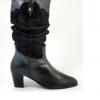
And now. . . for something completely different! Yesterday it snowed. Again. It's going to be one of those winters, apparently. It's not even Christmas, and I'm already wearing of removing snow. A couple of years ago, I got these vintage boots. Cobbies is the brand name. I got them because they are shearling lined, and I wanted some "heels" to wear when it was really cold. These boots feature 2 3/8" heels, which is right at about 6 cm. In other words, FLAT. Which suits me fine for the work I'm doing. I do consider them low heels in the grand scheme of thing, but they're flats. Let's be realistic. Where things get interesting is the coefficient of friction factor. The forefeet of these boots are quite grippy, while the heels, once covered in ice, are dangerously slippery. This leads to some interesting footwork, worthy of a ballerina or Latin dancer. Walking heel to toe on smooth concrete after walking in the snow can lead to catastrophe, so it's best to do the opposite--toe first. I demonstrated this to my 16 year old. He said do what you got to do. A reheeling with Vibram would probably solve this issue.
-
I'm not sure I understand any of that, given that the US tax system is very different in some respects to that of the UK. We cannot deduct the repair/improvement costs relating to our own (principal) residence from our taxable income, but we are not (yet!) taxed on any profit made when that residence is sold. Any other property we own is subject to tax on any resultant capital gain when disposed of - the gain being (broadly) the difference between selling price (less sale expenses) and total purchase price, i.e. original cost of land/buildings plus acquisition costs plus all improvement costs (but not simple repair/maintenance costs as arising). And of course any income from letting is taxable, after deducting most outgoings, including periodic repairs. One should be mindful too of the effective cost of the capital invested in a property, i.e. the interest paid on any mortgage loan or that which would have been earned otherwise if the property was bought for cash. In my own example I quoted earlier, I did not allow for 'lost interest' on the capital I invested, which would have been in the region of £20,000 during the period of reconstruction, so does make a fair dent in the notional profit if the property is sold. I agree that the cost of some almost invisible, but usually essential, work (such as electrics and plumbing) may not be apparent in the finished property. And the same applies to other remedial work relating to the fabric, such as wood/damp treatment. I question however how one could spend as much as $50,000 (£38,000) on even a full re-wire of a large house - four or five times what I would expect. But maybe CrushedVamp was including appliances and lighting etc, although those would scarcely be unnoticed.
-

The High Heeled Ruminations Of Melrose Plant
Shyheels replied to mlroseplant's topic in For the guys
North shore, sure. That makes sense! Offhand I can't think of any suburbs up there beginning with New, but then riffraff like me didn't frequent the North Shore -
Yes in Sydney, but north of the bay, so not Newtown. First floor flat in an area with older brick buildings. Near shopping and doctors. Only drove past it once back in 2016. New....something
-
The High Heeled Ruminations Of Melrose Plant
Shyheels replied to mlroseplant's topic in For the guys
A condo? In Newtown? We can’t be talking about the same place. The Newtown I’m thinking of in Sydney is an old neighbourhood, lots of run down old terrace houses. No condos. That’s an American thing. This was was a student ghetto near the University of Sydney, with lots of Greek, Lebanese and Asian immigrants as well, and pretty rough back in the day. - Yesterday
-
My parents bought a condo for my grandmother and aunt in Newtown in the late 70's, sold it 2010's. I bought my current house in 2014 and it has more than tripled in value. When I put a new house on this lot it will then quadruple in value. That's my 2026 plan.
-
It was probably so they could feel a bit warmer!
-
I took a bus to a nearby town today to do some shopping. I had thought about bringing my practice heels and practicing but I knew I was going to be doing a lot of walking and carrying a rucksack full of shopping so I went in my chunky heeled knee boots. As you say, both for men and women trainers seem to be de rigueur these days That said, winter - boot season - is the time of year when you will see the most heels. As I was liked around the town I did see a number of women in heeled knee boots. The men, with the exception of me, were universally in ratty trainers. Although I wasn’t practicing in my 12cm stilettos, it was nice to walk about the town in my chunky heels - it’s all good grist for the mill!
-
The High Heeled Ruminations Of Melrose Plant
Shyheels replied to mlroseplant's topic in For the guys
I lived in a very down at heel inner city neighbourhood called Newtown in Sydney many years ago when I was at university. At the time you could get one of the dilapidated old townhouses there for about 60k. I was much too smart to waste my money there … Today they are well into seven figures -
Hm I'm not that familiar with the tradition, you could be right. In public places I never seen anyone go barefoot with a Dirndl, mostly it was matching classic pumps or ballerinas.
-
I have always worn shorts in the summer, as did my father before me. However, neither of my two sons ever wore shorts after the age of about 10, and they don't show any sign of ever changing. Oddly enough, both of them have legs that are like tree trunks, and yet they have different mothers. They certainly didn't get that from me! I also know plenty of women who never wear shorts or an above the knee skirt. I don't want to say I never do it, but it is easier to wear my beloved wooden heeled sandals with shorts rather than stilettos. Probably absolutely no one outside a certain group thinks about it this way, but to me chunky wooden heeled sandals with shorts is far less radical looking than stilettos with shorts. There is probably almost no one in the general populace who makes such a distinction. @higherheels I always thought the only proper footwear with a Dirndlkleid is none at all, meiner Meinung nach. Certainly much better than sneakers.
-
It's the same for women. Every outfit is combined with sneakers nowadays. Even traditonal clothes like the "Dirndl" here in Germany.
-
The High Heeled Ruminations Of Melrose Plant
mlroseplant replied to mlroseplant's topic in For the guys
I do not know how we got here, but since we are here, that math really isn't mathing. Even assuming that you could actually deduct everything you put into your house, it's not like it's free money. It just means you don't have to pay income taxes on that money. I know people do it, but every time I've looked into buying a house to flip, the numbers just weren't there. It's one of those deals where if I actually lived there, yeah, it would be worth it, but as a means of making money on the side, it's a lot of work for very little gain. Plus, I don't have that kind of energy anymore. Having said that, I wish I could have predicted the insane increase in the price of houses in the last few years. I probably could have made some money off of that. -
Here in the United States anyway, "women" bikes do have step through frames were as "mens" bikes do. Some bikes are a sort of hybrid where they are nearly step-thru but not as low as a women's bike style. My daughter's mountain bike is that way, halfway between the two extremes.
-
I wonder deeply if it has to do with litigation? I see that everywhere, for instance new cars. It really is hard now to tell if a car is a Honda CRV, A Toyota Rav4, or a Ford Escape... they really all look very similar. And the reason for that is litigation. With ever car having to abide by the same crash worthy testing procedures, along with strict gas mileage allowances, etc, in order for everyone to meet the new standards, the creative box they can fit into means car's profiles, unibody, and seat makeup pretty much will be the same. Not sure what I mean? Consider the making of a pair of high heels. Lets say we come up with a contest where we all make a pair of high heels. The first pair has loose constraints. A pair of high heels, 13 CM tall, with Stilleto heel. In that, there would be a huge variation on what we all create. But, add in more parameters like color, made of leather and plastic, must enclose the toes via points, and have a closed arch, and suddenly all the shoes become incredibly similar. It matters little if it is cars, high heels, or even houses... everything to me is becoming bland because of fear of litigation. Couple all this with a more entitled society and I can envision a woman slipping on a banana peel, claiming it was not her fault because it was actually the style of shoe she was forced to wear, and soon everyone is wearing sneakers/trainers.
-
To me... and this is quite judgmental I know, it just seems those who are less disciplined enjoy AI whereas others of us do not. I do not even have voice recognition toggled on my phone, whereas my wife does. She has not typed a thing into her phone for a year and it is quite comical. A person without patience she screams at her phone often because it does not understand what she is trying to say and I just laugh because had she typed it out it would have just been wayyyyyyy faster. But as a teacher she uses AI for everything, especially establishing her lesson plans which to me means, she is proving she has little value. But she wants quicker/easier on everything in life. Me, I am more disciplined and like to work things out for myself. Often, when faced with easier to do or harder, I chose harder because life experience has shown that is the better path to take long term. A case in point: I walk 5-7 miles a day for weight loss, she uses medical injections. As for Fuzzy Logic and AI, I think that was a form of early AI. The washer and dryer combination units I see advertised as AI do indeed spin faster if they detect shaking, but also detect the moisture content of the clothes inside. There really is no fuzzy logic there as it either is or is not under a certain percentage of moisture content. But I think the AI part comes into play where the logic in the PLC allows it to keep going, or stop, based on what those sensors depict.
-
The High Heeled Ruminations Of Melrose Plant
CrushedVamp replied to mlroseplant's topic in For the guys
Because how much money you put into the house is immaterial because it can be wholly deducted off your taxes. It is however, a good way to show how much work had to go into a property. It is not perfect I realize, as it is possible to put in $50,000 worth of electrical work and be something no one would ever notice, but as a rule $50,000 generally shows a fair amount of work went into a property. $10,000... not so much. It is why I used the amounts to show how much work went into the place. But the actually amount spent has no basis on the profit of a house. It can be completed deducted off your income taxes. -
I agree - although we call it 'maths'! I spent almost 600 days over 4.5 years, with very little outside help, rebuilding a derelict flat (above a shop) to use as a holiday home for family and a few friends. The property has been for sale (although is currently let) and, if sold, I would expect the 'profit' to be in the region of £120,000 (before tax), which gives me a 'wage' of around £200 per day, which is roughly in line with what most tradesmen have been charging. The work itself, involving almost all trades - carpentry, plastering, electrics, plumbing, gas heating, decorating, etc - was enjoyable enough and ultimately fulfilling, but I'm not sure that (my increasing age and declining fitness aside!) I would want to do it again.
-
I am NOT a shorts wearer either, no matter how hot it is outside. Here, I do not think I am in the minority, but a few men do wear shorts all year, enough so that no one gives them a second look. I remember being at my chiropractor's office and a man came in wearing shorts, I remember because he kind of looked funny stomping off his shoes because we were having a snow storm and six inches of snow (150 mm) was outside. For dressing up, which you guys and gals know I do almost always, for truly formal events I do wear true dress shoes, but about 80 percent of the time I do wear plimsolls. The reason is simple. I try and match my shoes to my pants. With so many color variations of plimsolls, I can do that easily. And they are comfortable, easy to wash, and look good in my opinion. In super formal settings, not so much, but they are a huge staple of my fashion sense right now.
-
That is great to hear @Puffer but atlas with my new home, all that is here is woman wearing much boots it seems. (Lots of fisherwoman). But as the saying says, "what is seen in Europe, will be seen in the United States the following year. I saw that myself. It was around 2008 when I was in Ireland and saw a new fashion trend I never saw before, the miniskirt worn with leggings underneath it so those who were more timid could feel a little more secure. I liked the look, and it was but a year later it was suddenly all the rage in the United States... in 2009!
-
I was out and about in the London area on Wednesday, with much travelling by train and underground. Although the predominant footwear for both sexes seemed to be the usual trainers/sneakers/plimsolls, there were a fair mumber of women in high-heeled boots of various styles - most often with a cuban or block heel of around 3" height, but higher and slimmer heels were also in evidence, including a few 4" stiletto boots. I was briefly in a large shopping mall in West London at lunchtime and the mix among the shoppers was much the same. Alas, there was little of real interest to see in the shoe shop windows, although dressy shoes and sandals with 4" stilettos were still in evidence. I ended up at 5.30pm in the City of London (the principal finance/insurance business area for those unaquainted) for an Institute carol service at one of the very old City churches. Women working in the City have traditionally been more smartly (if usually conservatively) dressed and it was refreshing to note that a fair number of those enjoying an after-work drink outside the busy open bars around Leadenhall Market, or simply making their way homewards, were in high heels - typically courts or boots with a 3 - 4" slimmish or sometimes stiletto heel. And several attending the carol service were similarly shod, with one woman in her 30s completely at ease in patent courts with a near-stiletto 4" heel and another in suede knee-boots with a true 4" stiletto.
-
Shyheels is right. Very many men, of all ages, wear shorts in England (and the rest of the UK) for much or all of the May - September period whenever the weather allows - and often when it doesn't! I am in shorts and sandals as a matter of course during that period unless my activity requires otherwise. Twenty or thirty years ago, few men above school age would be seen in shorts unless for a sporting/recreational activity, and open sandals, especially if worn barefoot, were rarely seen except at the pool or beach - being considered too girly by many. What does surprise me is the huge popularity among men of trainers/sneakers/plimsolls in almost all modes of actvity, including with a suit or jacket/trousers in otherwise formal or semi-formal settings. Comfortable they may be - although in my view far from ideal when the weather is hot or very cold - but smart they are not. Here is Tim Davie, the recently-resigned Director-General of the BBC, in what appears to be his usual 'business' outfit of suit plus plimsolls. Hardly impressive.
-
Not at all! There’s a Scot moored just up from me who wears shorts when it’s below freezing. Lots wear shorts. I didn’t wear them when I lived in Australia either!
- Last week
-
@Shyheels "1 don't do shorts" is the same as "I live in Britain."